
Air sealing first
Sealing bypasses at ceiling penetrations, attic access points, and duct chases often reduces condensation more than adding insulation alone because it stops warm, humid air from reaching cold metal.
Serving Dayton, Ohio & surrounding areas
Mon–Sat · 7am–7pm
Condensation control · Dayton, Ohio
Stop drips, damp insulation, and musty odors with a clear plan: identify the moisture source, fix airflow and vapor control, and keep the roof system performing through Ohio's temperature swings.
Understand the moisture pattern
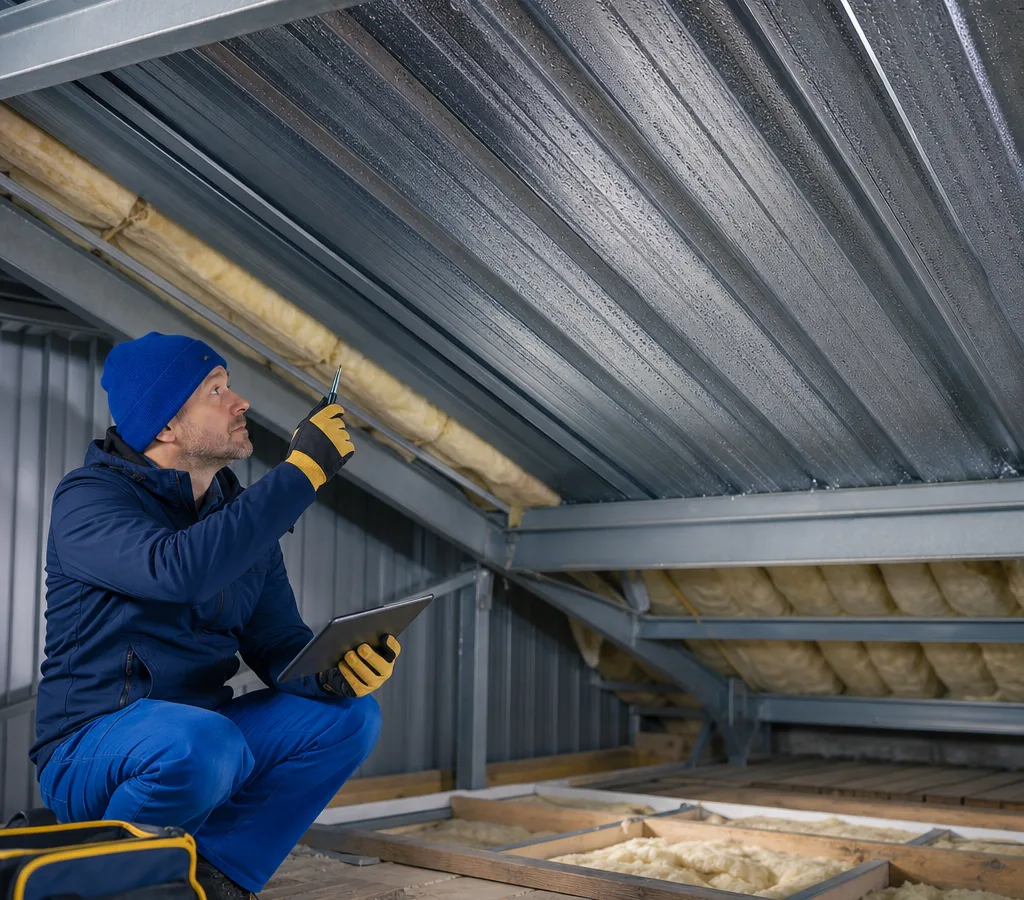
Metal roof condensation happens when warm, moist air meets a cold metal surface and drops below the dew point. In Dayton, Ohio, this often shows up during cold snaps, shoulder seasons—warm days followed by cool nights—and whenever indoor humidity is elevated by showers, cooking, drying clothes, or unvented heaters.
Common warning signs include:
The root cause is almost never the metal itself. Condensation is a building-science problem involving air leakage, missing or misplaced vapor control, insulation gaps, and inadequate ventilation. The right correction must match the roof system, the structure, and the way air moves through it.
Find the cause before choosing the fix
A lot of condensation complaints start as “my roof is leaking.” Sometimes it is, but condensation and rain intrusion behave differently.
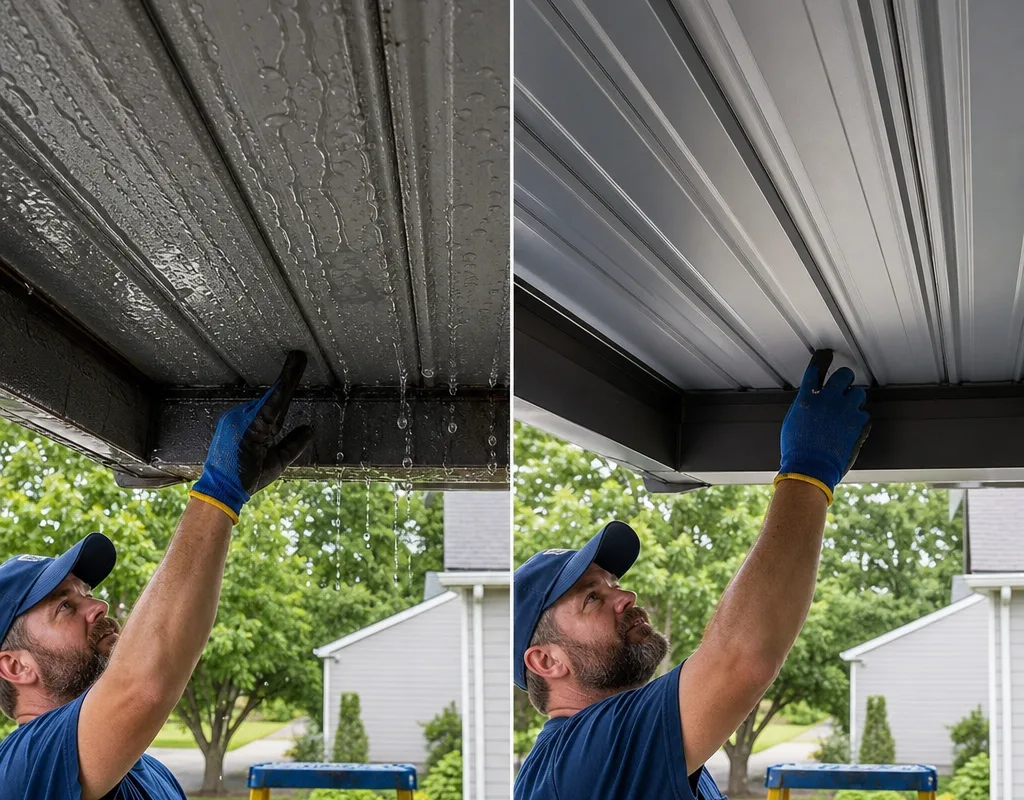
Condensation usually appears as broad dampness, droplets spread across panel undersides, or dripping that is worst in the early morning and during rapid temperature changes. Rain leaks tend to follow storms and appear in more defined paths near penetrations, valleys, transitions, or flashing.
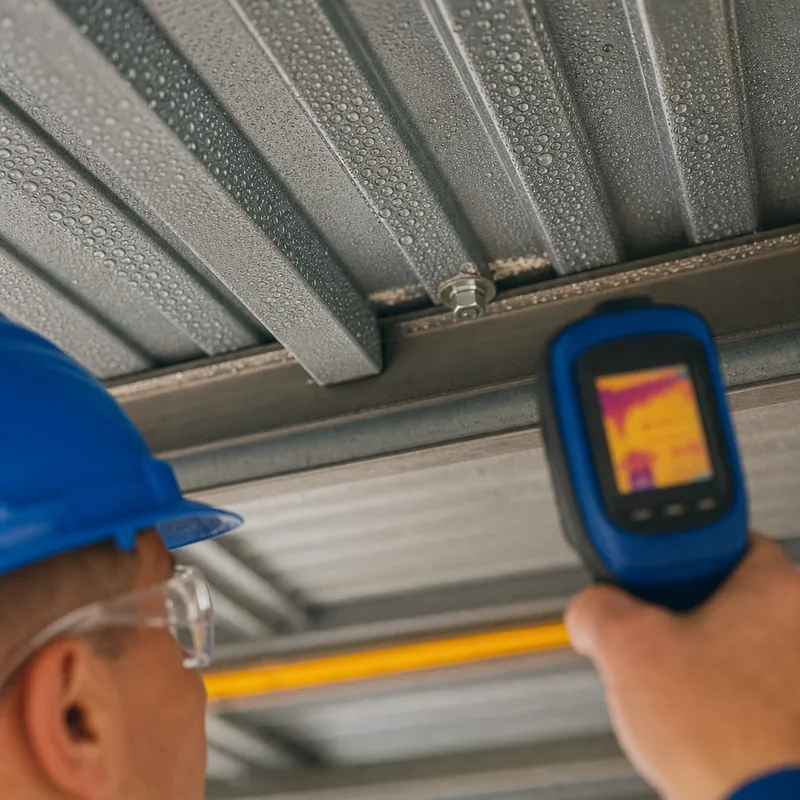
Our inspection focuses on where moisture originates and why it remains:
We also determine whether the pattern better matches wind-driven rain, ice backup, condensation, or a combination, then explain the next steps in plain language.
Assembly-specific solutions
Sealing bypasses at ceiling penetrations, attic access points, and duct chases often reduces condensation more than adding insulation alone because it stops warm, humid air from reaching cold metal.
A properly detailed vapor retarder helps keep indoor moisture from migrating into the roof system. Its location depends on the assembly; incorrect placement can trap moisture.
Condensation control typically needs both intake and exhaust. We evaluate soffit-to-ridge flow where applicable or other appropriate venting strategies for the structure.
For some assemblies, a high-temperature underlayment or condensation-control layer can help prevent droplets from forming beneath metal and protect insulation below.
Better R-value helps only when insulation stays dry and ventilation paths remain open. Baffles, correct thickness, and avoiding compression all matter.
Where a building generates substantial moisture, controlling indoor humidity may be necessary—especially in finished spaces where ventilation changes alone cannot keep dew point in check.
Diagnose, correct, verify
Condensation work is rarely a single product swap. It is a coordinated scope: diagnose, correct, and verify.
Inspect and map moisture. We examine where water appears, how the roof is assembled, and how the space is used. In finished areas, we also look for staining, soft drywall at the ceiling line, and damp insulation.
Identify the driving force. In many Dayton-area homes and shops, warm indoor air escapes upward during winter heating. When that moisture-bearing air reaches cold metal or framing, it condenses.
Match fixes to the assembly. The correct approach depends on whether the roof is vented or unvented, whether the space is conditioned, and what is accessible. Options may include air sealing, corrected intake and exhaust, properly specified underlayment, condensation-control layers, and adjusted insulation placement.
Address high-risk details. Pipe boots, exhaust vents, skylight curbs, wall-to-roof connections, transitions, and other locations where warm air can wash against cold metal receive special attention.
Confirm performance. After corrective work, we verify that ventilation paths remain open, insulation is not blocking airflow, and indoor moisture sources have been identified.
Persistent dripping or repeatedly wet insulation deserves a moisture-focused inspection rather than another symptom-level patch.
Inspection to handoff
A structured process separates condensation from active leakage, then targets the moisture pathway instead of repeatedly patching symptoms.
We review the roof type, interior conditions, and where moisture appears. You receive a straightforward explanation of whether the pattern looks like condensation, rain entry, or both.
We outline practical options based on access and goals, including air sealing, ventilation corrections, insulation adjustments, or assembly changes that prevent droplets beneath metal.
We coordinate around weather and building use, then discuss which attic accesses, stored items, pole-barn areas, or ceiling panels need to be cleared.
Work follows the agreed scope, with attention to penetrations, transitions, insulation continuity, and maintaining clear airflow paths.
We explain what changed, what to watch during the next cold snap, and which building-use steps can help keep indoor humidity in a safer range.
Plan around the actual assembly
Most metal roof condensation repair work in Dayton typically ranges from about $350 to $1,500 for targeted fixes such as air sealing, small ventilation corrections, and minor insulation adjustments. Larger scopes involving roof-layer rework, condensation-control materials, or widespread ventilation and insulation corrections often run $1,500 to $6,000+.
Your actual price depends on roof height and access, how much of the assembly can be reached without demolition, the number of penetrations and transitions, existing insulation condition, and whether the issue is pure condensation or mixed with active leaks. Exact pricing is confirmed after an on-site assessment of the roof and interior moisture pattern.
Dry assemblies by design

Questions before an inspection
That pattern points to condensation: warm, humid indoor air is reaching cold metal and becoming water droplets. In Dayton winters, dripping can appear overnight or in the morning even under clear skies. A site check focuses on air leaks, insulation gaps, and whether ventilation is moving air from intake to exhaust.
Sometimes, but insulation alone is unreliable when warm air still leaks into the roof cavity. Wet insulation also loses performance quickly. The typical sequence is air sealing first, followed by insulation improvements and then ventilation or vapor-control adjustments based on the assembly.
The fastest improvement usually comes from reducing indoor humidity and preventing moist air from contacting cold metal. That can mean sealing major air leaks and using appropriate ventilation or a condensation-control layer. Vehicle storage and unvented propane heaters can create heavy moisture loads, so building use is part of the diagnosis.
A ridge vent helps only when adequate intake air and a clear airflow path are present. If soffit intake is blocked by insulation or the roof lacks continuous intake, the ridge vent cannot move enough air. An inspection checks the entire path rather than simply confirming that a vent exists.
Yes, when the correct underlayment is selected and detailed for metal roofing. Some assemblies benefit from high-temperature underlayment and, in certain cases, a dedicated condensation-control layer. The appropriate choice depends on roof type, slope, and whether the space below is conditioned.
Condensation typically creates widespread droplets or frost beneath panels and correlates with cold mornings and indoor humidity. Flashing problems usually cause localized staining and wetting after storms near penetrations or transitions. We compare the moisture pattern with roof details and inspect suspect boots, vents, and wall connections.
Control moisture at the source
Tell us what you are seeing and what type of building it is. Metal Roofing Dayton OH will inspect the moisture pattern, explain the cause, and provide a clear scope to control condensation for the long run.